Of everything that affects how wine ages, temperature matters most. Light, humidity and vibration all play a part, but a bottle kept too warm, or one that swings between warm and cool, will change faster than any other way you could mistreat it. That’s why a temperature-controlled wine cellar is the foundation of serious wine storage.
Here’s what the ideal cellar temperature is, what happens when you miss it, and how a temperature-controlled cellar compares with the other places people keep wine.
The Short Answer
- Ideal temperature: about 55°F (13°C). Anywhere from 50–59°F works if it stays steady.
- Ideal humidity: 60–70% relative humidity.
- Stability matters as much as the number. Small, slow changes are fine. Daily swings of several degrees are not.
What Is a Temperature-Controlled Wine Cellar?
A temperature-controlled wine cellar is an insulated, sealed room or enclosure with a dedicated cooling system that holds wine at a steady cellar temperature year-round. Unlike a regular room, or even a cool basement, it doesn’t depend on the weather or your home’s air conditioning. The cooling unit is designed specifically for wine. It runs at higher temperatures than a household air conditioner and manages humidity, so the air doesn’t become too dry.
It can be a full custom room, a converted closet, the space under the stairs, or a glass-enclosed wine room in the middle of the home.
Why 55°F?
About 55°F has long been considered the sweet spot for aging wine. It’s roughly the temperature of the deep underground caves in Europe where wine has been stored for centuries. It’s cool enough to slow the chemical reactions that age wine, but not so cold that development stalls.
One important point: storage temperature isn’t serving temperature. Every wine, red, white or sparkling, is stored at the same cellar temperature. You adjust only when it’s time to pour. Our Holiday Wine Playbook includes a serving temperature chart.
What Heat Does to Wine
Warmth speeds up aging. A common rule of thumb among collectors is that every 10°F or so above cellar temperature roughly doubles the rate at which wine develops. A bottle that would peak in ten years at 55°F may be past its best far sooner in a 70°F room.
| Storage Temperature | What Happens to Wine |
|---|---|
| Below 45°F | Aging slows almost to a stop. Fine for short periods, but wine won’t develop. |
| 50–59°F | The ideal range for aging and long-term storage. |
| 60–70°F | Wine ages faster. OK for bottles you’ll drink within months. |
| Above 75°F | Fruit flavors fade, and wine can taste flat or “cooked” over time. |
| Above 80°F | Real risk of heat damage. Wine can expand and push the cork. |
Why Temperature Swings Are Just as Harmful
When wine warms up, it expands. When it cools, it contracts. Repeated daily swings act like a slow pump, pushing wine against the cork and pulling air back in. Over months, that can lead to seepage, oxidation and tired-tasting wine. A cellar that sits at 58°F every day is better than one that bounces between 50°F and 65°F, even though the second one averages lower.
Temperature-Controlled Cellar vs. Other Storage Options
| Option | Temperature Control | Best For |
|---|---|---|
| Kitchen or living area | None. Follows the house, usually 68–75°F. | Bottles you’ll open within a few weeks |
| Basement or interior closet | Cooler, but still shifts with the seasons | Short- to medium-term storage |
| Wine refrigerator | Good, for a limited number of bottles | Small collections and everyday wine |
| Temperature-controlled cellar | Precise and steady year-round, with humidity managed | Growing collections and aging wine for years |
A wine fridge is a great start, but most hold a few dozen bottles and keep them out of sight. A temperature-controlled cellar scales with your collection and turns it into a display.
Signs You Need a Temperature-Controlled Wine Cellar
- You own bottles you plan to age for more than a year.
- Your collection has outgrown your wine fridge.
- You live in a warm climate, like South Florida, where no room in the house stays near 55°F.
- Your “wine storage” is a closet, pantry or garage that changes temperature with the seasons.
- You’ve opened a special bottle and found it flat, tired or leaking around the cork.
What Makes a Cellar Hold Its Temperature
A cooling unit alone doesn’t make a cellar. Steady temperature comes from four things working together:
- Insulation and a vapor barrier that keep heat and moisture out. See The Cold Truth About Wine Cellar Insulation.
- A sealed, insulated door with a full gasket and threshold seal.
- A properly sized cooling system made for wine. Learn how wine cellar cooling units work.
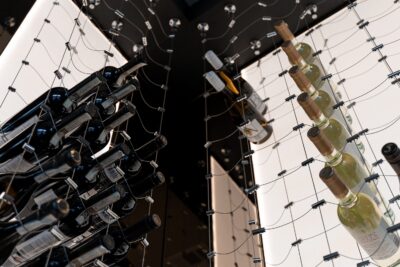
- Racking that lets air circulate. Open cable wine racks keep air moving around every bottle, so there are no warm pockets.
Ready to build? Our step-by-step guide on how to build a temperature-controlled wine cellar walks through every stage, and The Wine Cellar Design Process shows how a project comes together with our team.
Display and Protection, Together
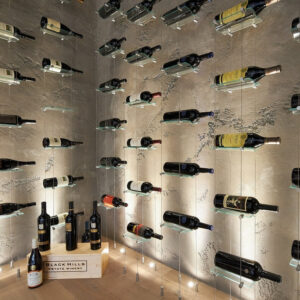
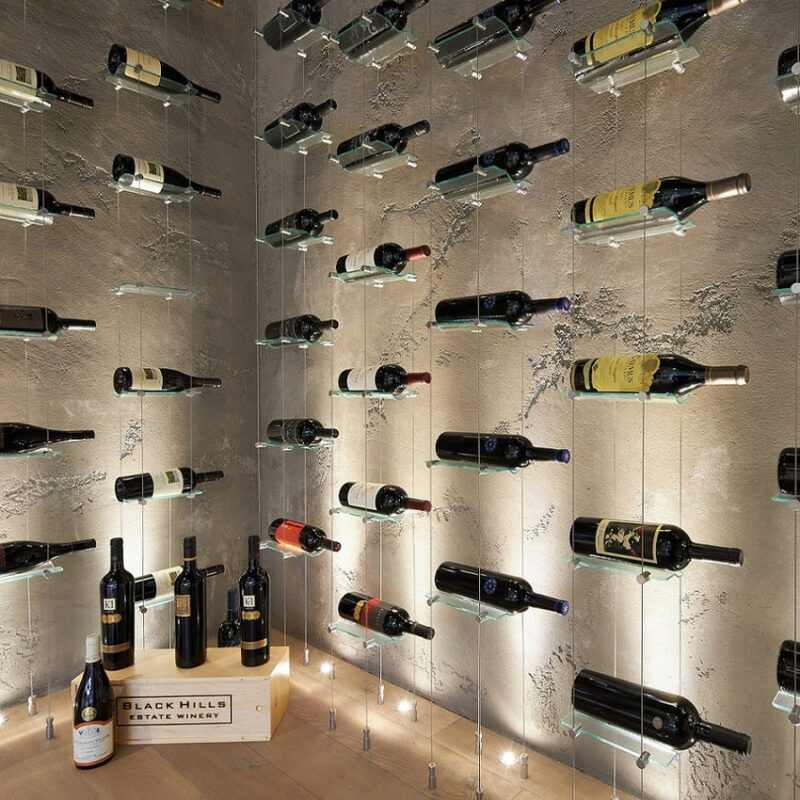
A temperature-controlled cellar doesn’t have to be hidden in the basement. With insulated glass and floating racking, it can be the centerpiece of your home. Cables & Glass, Invisible Cables and Premium Cables all keep every label facing forward while your wine rests at the perfect temperature. Read Glass + Cable: How to Avoid Condensation before you design a glass room.
Frequently Asked Questions
What temperature should a wine cellar be?
About 55°F (13°C) is ideal, with 60–70% humidity. Anywhere between 50°F and 59°F is fine as long as it stays steady.
Should red and white wine be stored at different temperatures?
No. All wines can be stored at the same cellar temperature. Only serving temperatures differ.
Can I use a regular air conditioner to cool a wine cellar?
It isn’t recommended. Household air conditioners are designed to cool people to around 70°F and pull moisture out of the air. Wine cellar cooling units are built to hold 55°F while keeping humidity in the right range.
Is a wine fridge the same as a temperature-controlled cellar?
A wine fridge controls temperature for a small number of bottles. A cellar does the same for an entire collection, manages humidity, and can double as a showpiece.
Protect Your Collection at the Perfect Temperature
Whether you’re converting a closet or designing a glass wine room, our team can help you plan a temperature-controlled cellar that protects your wine and shows it off. Call us at 833-833-3079 or schedule a complimentary design consultation.